
Mandatory Earnings Calls: Preparing Saudi Listed Companies and IPO Candidates
News
02.10.2026
BD Team
The CMA proposes mandatory earnings calls for Saudi Main Market issuers. Robert Vydra examines the proposed timetable, financial guidance and practical preparation steps for listed companies and IPO candidates.
The CMA proposes twice-yearly earnings calls for Main Market companies.
Saudi listed companies would need to explain their results, discuss future financial performance and answer investors’ questions within five business days of releasing annual and second-quarter interim results. Preparation would need to begin before the results announcement.(1)
Published on 29 September 2026G, the proposal would make earnings calls a regular requirement for Main Market companies. Issuers should assess whether reporting systems, management preparation and disclosure controls can support the proposed timetable. IPO candidates should incorporate that assessment into their readiness work.(1)
CONSULTATION TIMETABLE
Comments close on 29 October 2026G. The draft envisages commencement from the announcement of annual financial results for 2026G, subject to final approval. The requirements remain proposals and are not yet in force.(1)
CMA proposal describes the draft requirements. Practical implications and preparation steps reflect our analysis and recommendations.
What the draft would require
Scope and frequency. Companies listed on the Main Market would hold two calls each year: one after announcing annual financial results and one after announcing second-quarter interim financial results. The draft does not extend this requirement to Nomu companies.
Timing and access. Each call would take place within five business days of the relevant results announcement and after market close. The Company would announce the call on its website, explain how it would be conducted and specify the registration process.
Discussion and publication. Company representatives would discuss financial results, guidance on future financial performance, challenges and opportunities, and answer participants’ questions. The presentation and recorded call would be published immediately on the Company’s website.
Financial guidance needs particular attention
CMA proposal. The draft expressly includes guidance on future financial performance among the subjects for discussion. It does not specify mandatory numerical indicators, a forecast horizon or a prescribed form of guidance. It should therefore not be described as requiring every listed company to publish a quantified annual profit forecast.
Practical implications. Management should agree what it can support with evidence before speaking publicly. Any outlook should identify the relevant period, material assumptions and uncertainties. Changes from earlier guidance should be explained consistently across the results announcement, presentation and answers. A general disclaimer cannot substitute for a properly supported statement.
The separate IPO consultation proposes forward-looking information and forecasts covering at least one year. If both measures are adopted, newly listed companies would need a process for explaining performance against the expectations disclosed during the Offering. The earnings-call draft does not itself reproduce the IPO forecast requirements or the proposed financial adviser diligence obligation.(2)
Existing disclosure duties would continue
Articles 63 and 64 of the Rules on the Offer of Securities and Continuing Obligations require accurate, non-misleading disclosure and disclosure of material developments without delay. A scheduled call would not justify deferring a required announcement. Nor should publication of a recording on the Company’s website be treated as satisfying every applicable disclosure requirement.(3)
Presenters should know how to handle questions involving unpublished material information. Legal and investor relations teams should agree an escalation process for unexpected statements, possible corrections and any separate market announcement that may be needed.
How companies should prepare
Build the call into the reporting calendar. Prepare the presentation, supporting data and anticipated questions alongside the results announcement. Allocate responsibility for financial verification, legal review, approval, recording and publication. Resolve inconsistencies before releasing results.
Rehearse substantive questions. Management should be able to explain changes in revenue, margins, cash generation and material business risks. For IPO candidates, a rehearsal using an actual reporting period can reveal gaps in management information and weaknesses in the explanation of performance before listing.
Document the basis for guidance. Keep dated assumptions, reconciliations and approvals supporting the outlook. Review whether subsequent developments require an update rather than waiting for the next scheduled call. Distinguish a revised expectation from an error in the original disclosure.
Test access and publication. Confirm that registration, recording and website arrangements work, including a contingency for technical failure. Retain the approved presentation, recording and supporting materials. The draft does not prescribe a retention period or require a transcript.
Points worth addressing in consultation
Clarification would be useful on the expected content and level of detail of financial guidance, who may register and participate, notice periods and language arrangements. Other open points include technical interruptions, participation by named executives and the treatment of newly listed companies.
Issuers should identify preparation gaps now, while the requirements remain under consultation, so that management can discuss performance confidently and consistently with the Company’s public disclosure.
Robert Vydra | Partner | rvydra@statlawksa.com
Sources and notes
(1) CMA consultation announcement, 29 September 2026G. Consultation closes on 29 October 2026G. Announcement
(2) CMA, separate consultation on enhancing IPO practices, 22 September 2026G. IPO consultation
(3) Rules on the Offer of Securities and Continuing Obligations, Articles 63 and 64, amended 19 January 2026G. Rules
This alert reflects the proposal as of 2 October 2026G. The proposal is appended in an unofficial English translation followed by the Arabic original, which should be consulted for its precise terms.
Disclaimer
The opinions expressed in this client alert are solely those of the author and do not represent the views of any other party. This content is provided for informational purposes only and should not be construed as legal advice on any subject matter. No recipient of this client alert, clients or otherwise, should act or refrain from acting based on any content included herein without seeking appropriate legal or other professional advice on the particular facts and circumstances at issue from an attorney licensed in the recipient’s jurisdiction. The content of this client alert is intended to provide a general guide to the subject matter and may not necessarily capture the latest legal developments.

Robert Vydra
Robert Vydra is Partner and Head of Equity Capital Markets at STAT Law Firm in Riyadh. A New York-qualified lawyer, Robert has focused on…


Saudi Investment Funds: Key Takeaways from the CMA 2025 Annual Report
News
30.09.2026
BD Team
STAT shares an analysis of the CMA 2025 Annual Report and its practical implications for fund managers, sponsors and investors in the Kingdom.
In this analysis, STAT Managing Partner Mishari A. S. Alabbad, sets out what the data indicates for managers, sponsors, and investors.

Mishari A. S. Alabbad
Mishari is a partner in the capital markets and real estate practice. Mishari is now considered one of the leading Saudi legal advisors in…
Saudi IPO Reset: The CMA’s Proposed Overhaul of Underwriting, Institutional Bidding and Forecast Disclosure
News
24.09.2026
BD Team
STAT examines how the CMA’s proposed IPO reforms could reshape underwriting, bidding, and transparency for Saudi equity markets.
The CMA’s proposed overhaul of underwriting, institutional bidding and forecast disclosure.
Saudi IPOs could change for everyone at the table. Underwriters would commit before the order book is built, institutional bids would need demonstrable liquidity and issuers would publish financial forecasts.(1,2)
Published on 22 September 2026G, the consultation would reshape three connected elements of the IPO process: who carries execution risk, what makes institutional demand credible and which information supports the Offering price. Its practical effect would depend on the final provisions and implementation arrangements.(1,2)
CONSULTATION TIMETABLE
Comments close on 22 October 2026G. The CMA announcement identifies 2 November 2026G as the intended effective date, subject to final approval. These are proposals, not rules already in force.(1)
CMA proposal identifies the draft requirements. Practical implications sets out their likely effects. Alternative considerations identifies the author’s suggestions, not provisions in the draft.
Today’s position: commercially soft underwriting
Current framework. Main Market IPOs are already required to be fully underwritten by one or more appropriately licensed Capital Market Institutions (CMIs). The current Book-Building Instructions require the underwriting agreement to be signed before the subscription process begins. They do not require it to be effective before book-building starts.(3,4)
Market practice. In typical Main Market IPO practice, the underwriting agreement is signed only after the institutional Offering and book-building have been completed and the Offering priced. With demand established at that point, underwriting is commercially “soft”: it principally backstops settlement risk, including an investor’s failure to pay, rather than guaranteeing at launch that sufficient institutional demand will emerge.
The description of current underwriting as “soft” does not make the agreement non-binding once effective. It describes when the underwriter assumes its purchase obligation and the residual risk it principally covers, subject to the agreement’s terms and conditions.
From settlement backstop to earlier demand risk
Weak demand can stop an IPO before the customary underwriting agreement is signed. Saudi IPOs have previously been cancelled for lack of sufficient demand. This illustrates the distinction between an underwriting requirement and a commitment that protects against an unsuccessful institutional marketing process.
CMA proposal. The draft would require the underwriting agreement to be signed and effective before book-building begins, with the underwriter’s obligation to purchase all Offer Shares becoming effective when book-building starts. This would move the commitment into the period in which demand and the final Offering price are still being established.(2)
THE COMMERCIAL CHANGE
The proposal is not simply to require full underwriting. It is to require the commitment before the institutional book has demonstrated that the Offering can be sold.
Hard underwriting: capacity, competition and cost
Practical implications. Earlier underwriting could strengthen incentives for disciplined pricing and give issuers and selling shareholders greater certainty of payment, subject to the final rules and contractual conditions. It would not eliminate market risk, guarantee a listing or protect investors against subsequent price falls. Instead, underwriters would assume demand risk earlier and could face a longer holding period for unsold shares.
Whether current CMIs have sufficient capacity is a transaction-specific and market-wide question, not something that capital-adequacy ratios alone can answer. The CMA’s first-quarter 2026G report publishes institution-level ratios, but these do not establish unused underwriting capacity or immediately available funding. Assessment would require each proposed underwriter’s eligible capital, liquidity, concentration limits, committed funding and concurrent exposures.(5)
Current prudential framework. The current Prudential Rules calculate the underwriting capital requirement using the net underwriting position, applicable security risk charges and an underwriting risk factor. Qualifying written third-party subscriptions and sub-underwriting commitments can reduce that position. This is not a blanket requirement to hold regulatory capital equal to the full Offering value. Capital adequacy and the cash needed to complete purchases are separate questions. Earlier commitments could bring forward or increase exposure before qualifying subscriptions or sub-underwriting are secured; revocable book-building orders should not be assumed to qualify for deduction.(6)
Earlier and potentially larger exposures could favour institutions with more deployable capital, narrow the pool willing to underwrite some IPOs and increase fees or the pricing discount sought before launch. Smaller or less liquid Offerings could be affected disproportionately. Syndication and separate advisory and underwriting roles could sustain participation by smaller CMIs, depending on the final framework. Whether total IPO costs would become prohibitive cannot be concluded at this stage. Any additional fees or reduction in proceeds would need to be considered alongside the potential savings from fewer failed Offerings and greater execution certainty.
Alternative considerations. An alternative identified by the author, and not included in the CMA proposal, would allow the issuer and underwriter to agree commercially whether the underwriting is structured on a “hard” or “soft” basis, including when the underwriter’s purchase obligation becomes effective. Full underwriting and the applicable prudential requirements would remain mandatory. The aim would be to preserve transaction flexibility and avoid unnecessarily constraining IPO activity, while recognising that soft underwriting provides less certainty against an insufficient institutional book. Implementing this alternative would require the final regulatory framework to permit that flexibility. The prospectus should in all cases clearly disclose the structure, timing and scope of the purchase obligation, any material conditions and termination rights, and who bears the risk of insufficient demand.
If the underwriting prevents listing
CMA proposal. If the underwriter’s ownership of the Offer Shares results in the Listing Rules’ requirements not being met, the issuer’s shares would not be listed, but the underwriter would nevertheless have to purchase all Offer Shares.(2)
Practical implications. The provision preserves the purchase obligation without disapplying the admission requirements. The underwriter’s exposure could therefore include ownership of unlisted shares, rather than merely a temporary settlement shortfall.
The existing Listing Rules already permit the Exchange, with CMA approval, to accept a lower public-ownership percentage or shareholder number. They also provide for remedial periods for shortfalls arising after listing. Those provisions do not create an automatic grace period for an IPO that fails the admission requirements. An IPO grace period would require express regulatory approval and coordination with the proposed no-listing outcome.(7)
Alternative considerations. The author suggests considering case-by-case admission where the only obstacle is a temporary shortfall in public ownership or shareholder spread caused by the underwriting. The issuer, supported by the underwriter, could have a defined grace period to achieve the required public distribution, without releasing the underwriter from its purchase obligation. This is an alternative for consultation, not the CMA proposal.
Such an approach would involve a trade-off. It could preserve a route to listing and an orderly sell-down, but limited initial liquidity and subsequent underwriter disposals could affect price formation and public investors. Potential safeguards would include a minimum viable public float and shareholder spread at admission, a credible placement plan, transparent disclosure, a fixed deadline, regulatory monitoring and clear consequences if the shortfall is not remedied. It would not provide a route to listing where there is no genuine public market.
Underwriting terms the final framework would need to address
Pricing and commitment. Under the CMA proposal, the agreement would need an executable pricing mechanism before price discovery is complete, addressing the price range, authority to determine the final price, any minimum acceptable price and the consequences of an insufficient book.
Conditions and termination. The draft does not specify a complete regime for conditions precedent or termination rights. The treatment of market-disruption provisions, material adverse change clauses and other protections would require clarification. Neither unrestricted withdrawal nor an absolute prohibition on termination rights should be assumed.(2)
Capital, syndication and failed listing. Underwriters would need to assess funding capacity before launch, risk allocation within any syndicate and the mechanics of acquiring shares if listing cannot proceed. Issuers and selling shareholders would need corresponding certainty over payment, transfer and completion.
A more dependable institutional order book
Current framework. The existing framework already requires verification of participating entities’ solvency and ability to pay before bids are registered.(4)
CMA proposal. Orders must reflect the investor’s actual available liquidity, with financial-capacity verification limited to cash or cash equivalents. The draft expressly includes securities capable of conversion into cash within the subscription-payment period as an example.(2)
Participation forms would also need to provide for orders through the official channel designated by the financial adviser and the prospectus timetable. A bid at a specified price within the range would include all lower prices within that range, and official orders would become binding for payment no later than the stated subscription-payment deadline.(2)
Practical implications. Importantly, the draft preserves the existing mechanism permitting bids to be amended or cancelled during book-building. It should not be described as making every bid irrevocable from submission. Nor does it expressly impose universal cash pre-funding: acceptable evidence, the treatment of liquid securities and the point at which payment becomes binding need to be reflected in the final rules and transaction documents.(2,4)
Alternative considerations – understanding demand quality. A confidential book-quality assessment could examine price sensitivity, order concentration, revisions, cancellations, funding and allocations rather than rely on a single oversubscription multiple. The author’s suggestion would complement the proposed liquidity verification while keeping investor identities and detailed orders out of public disclosures, without restricting access by the CMA or other authorised recipients.
A more prescriptive alternative would be to require full or partial prefunding for specified categories of orders, such as unusually large orders or investors whose funding capacity cannot otherwise be verified. This could provide stronger payment certainty without imposing universal prefunding across the institutional book. Any such requirement would need to be calibrated carefully, since immobilising cash before pricing and allocation could discourage participation and impair price discovery. Any unfunded portion of an order would still require satisfactory evidence of funding capacity.
Forecast disclosure under the proposals
CMA proposal. The prospectus or registration document would have to include issuer-specific forward-looking statements and forecasts, including financial performance indicators, covering at least one financial year. These must also be made available through the documents-for-inspection section and must be clear, not misleading and based on reasonable, measurable assumptions.(2)
The financial adviser would have an express obligation to exercise professional due care and reach a reasonable opinion on those statements and forecasts. The draft refers to both the Main Market prospectus requirements and the Parallel Market prospectus and registration-document provisions, so the forecast limb should not be treated as a Main Market-only measure.(2,3)
Why mandatory forecasts require caution
Practical implications. Making forecasts compulsory is not a cost-free transparency measure. A published number can look more precise than its assumptions justify and can come to be treated as a promise rather than an estimate. Investors may anchor valuation to it, while management may face pressure to deliver it despite changing conditions. A subsequent miss could damage confidence and invite scrutiny of the original disclosure, even where it reflects developments that could not reasonably have been foreseen.
The central danger is hindsight. A forecast is prepared with an incomplete view of the future but may later be examined when both the outcome and its causes are known. A fair assessment should distinguish genuinely later developments from adverse facts that existed, were known or should reasonably have been identified through diligence when the forecast was prepared or reaffirmed. Information withheld from advisers is not the same as information that did not yet exist.
For issuers, this would require more than inserting a management budget. The forecast should be reconciled to the business plan and historical information, with dated assumptions, the information then available, sensitivities, management and board review, and the adviser’s work retained. The adviser’s diligence would need to test the basis of the forecast, not merely its arithmetic. A variance should prompt analysis of its cause, not an automatic conclusion that the original forecast was defective. Conversely, a generic warning about uncertainty would not cure an unsupported assumption or material omission.(2,8)
Liability and hindsight concerns are important reasons for caution about publishing management forecasts in IPOs. In the US, projections are often omitted from conventional IPO prospectuses, and the statutory forward-looking-statement safe harbour excludes IPOs. That is not a prohibition: the SEC notes that some types of IPO regularly include projections. Nor is there a uniform international approach. UK rules require an outstanding, valid published profit forecast to be included and now offer conditional protection for qualifying forward-looking statements. These differences illustrate that there is no single international model. An important question for consultation is therefore whether mandatory forecasts are the best means of improving the information available to investors in Saudi Arabia, or whether greater emphasis should instead be for example placed on the freshness of historical financial information, including by limiting the period between the latest financial information in the prospectus and the Offering and listing (currently up to 12 months). (9)
The draft does not specify the required financial indicators, resolve whether a part-completed financial year satisfies the minimum horizon or expressly require an auditor’s assurance report. Guidance would also be useful on how the new forecast obligation would operate alongside existing updating duties at approval, pricing and listing.(2,3)
If a forecast is missed: existing-law implications
Practical implications. A shortfall alone does not establish a disclosure breach or automatically entitle investors to compensation. The questions are whether the original disclosure was materially incorrect or incomplete, whether the relevant duties were discharged and whether later developments were disclosed when required. The draft creates no automatic fine, buy-back obligation or delisting consequence for a numerical miss.(2,8)
For a Main Market IPO, a material forecast change after prospectus publication and before completion may trigger a supplementary prospectus under Article 29 of the Rules on the Offer of Securities and Continuing Obligations. CMA approval is required, and earlier subscribers may rescind or amend subscriptions before the Offering ends. Parallel Market transactions have separate supplementary-disclosure provisions. After listing, a material deterioration in expected performance must be assessed under the applicable continuing-disclosure requirements; an issuer should not wait for scheduled results where prompt disclosure is required.(3)
An actionable prospectus misstatement or omission may expose the issuer and other responsible persons to compensation claims under Article 55 of the Capital Market Law, subject to its materiality, loss and other requirements. The issuer cannot rely simply on good faith or lack of knowledge. Specified directors, senior officers and underwriters have statutory defences, including reasonable investigation in the circumstances prescribed by Article 55. A breach of applicable duties may also attract regulatory action. Neither compensation liability nor a regulatory sanction follows from a numerical miss alone.(8)
The financial adviser’s proposed duty of professional due care would be a separate compliance requirement, not a promise that the forecast will be achieved.(2)
Commercially, a missed forecast could affect valuation, investor confidence and the terms of subsequent fundraising even without a legal breach. A clear explanation should distinguish changed market conditions, operational execution and assumptions that no longer hold, rather than leave investors to infer that every shortfall reflects the same problem.
If adopted, how the changes could affect IPOs
Issuers and selling shareholders. The changes could affect launch timetables, underwriting negotiations and the economics of going public. Preparing, verifying and approving published forecasts would become a substantive workstream. Financial models would need to support the proposed disclosure, while the earlier underwriting commitment could influence the price and terms on which an Offering proceeds.
Financial advisers, bookrunners and underwriters. Internal risk approvals, funding arrangements and syndication would need to precede the earlier commitment. Participation forms and liquidity-verification procedures would need to align with the prospectus timetable and payment obligations. Financial advisers would also have an express diligence responsibility for issuer forecasts.
The consultation raises implementation questions rather than immediate new compliance duties as the new requirements are still only at the proposal stage. The final provisions would determine the allocation of underwriting risk, the acceptable evidence of liquidity and the scope of forecast disclosure. The priority now is to assess these changes against planned IPOs and identify practical points for consultation.(1,2)
Disclaimer
The opinions expressed in this client alert are solely those of the author and do not represent the views of any other party. This content is provided for informational purposes only and should not be construed as legal advice on any subject matter. No recipient of this client alert, clients or otherwise, should act or refrain from acting based on any content included herein without seeking appropriate legal or other professional advice on the particular facts and circumstances at issue from an attorney licensed in the recipient’s jurisdiction. The content of this client alert is intended to provide a general guide to the subject matter and may not necessarily capture the latest legal developments.
Robert Vydra
Robert Vydra is Partner and Head of Equity Capital Markets at STAT Law Firm in Riyadh. A New York-qualified lawyer, Robert has focused on…

STAT Authors Saudi Arabia Chapter of the International AI in Financial Services Review 2026/27
News
20.09.2026
BD Team
STAT authored the Saudi Arabia chapter of the International AI in Financial Services Review 2026/27, outlining the regulatory framework for AI, robo-advisory rules and emerging policies in the Kingdom's financial sector.
STAT Authors Saudi Arabia Chapter of the International AI in Financial Services Review 2026/27
STAT is pleased to have authored the Saudi Arabia chapter of the International AI in Financial Services Review 2026/27, published by Beaumont Capital Markets.
With 2026 designated the Year of Artificial Intelligence, the chapter maps how AI in the Kingdom’s financial sector is governed. There is no single AI statute. Instead, requirements are spread across SDAIA, the CMA, SAMA, the Insurance Authority and the NCA. The chapter also covers the CMA’s new robo-advisory regime, cross-border data and cloud requirements, and the draft policies expected to shape the next phase.
Working where technology, regulation and finance meet, our team continues to advise banks, fintechs and investment firms on AI governance, data protection and regulatory engagement across the Kingdom’s evolving landscape, in support of Vision 2030.
Authored by Partner Zeyad AlSalloum, Senior Counsel Richard Blackburn and Associate Abdullatif Alharbi.
As AI reshapes the Kingdom’s financial sector, this chapter reflects STAT’s commitment to guiding clients through each regulatory development with clarity and confidence, setting the new legal standard.
-
Read the Full Chapter: Saudi Arabia Chapter | AI in Financial Services Review 2026/27

Zeyad Y. AlSalloum
Zeyad’s experience cuts across different practice areas and includes advising private sector and government clients in relation to large,…

Abdullatif Alharbi
Abdullatif, an associate specializing in banking law and debt capital markets, is a licensed lawyer in Saudi Arabia, admitted by the…

More Foreign Ownership: What Does Saudi Arabia Actually Gain?
News
14.09.2026
BD Team
In the final instalment of his four-part series on foreign investment in Saudi equities, STAT Partner and Head of Equity Capital Markets Robert Vydra examines how broader international participation can support corporate funding, domestic capital recycling and deeper Saudi capital markets.
The debate around foreign ownership in Saudi equities often focuses on the percentage: how much international investors are permitted to own, and whether that ceiling should rise. The more important economic question is what a broader international investor base can actually do for Saudi companies, Saudi capital markets and the wider economy.
The answer is broader than simply “bringing money in”. Foreign capital can support the economy through three connected channels: direct capital formation, domestic capital recycling and market deepening. These benefits can arise within the existing framework; further liberalisation could increase their scale.
Fresh equity for Saudi corporate growth
Where foreign investors subscribe for newly issued shares in an IPO, follow-on offering or rights issue, the link is direct. The company receives fresh equity that can fund expansion, capital expenditure, acquisitions or working capital without increasing leverage. Equity proceeds can also be used to repay debt and strengthen the balance sheet.
This distinction matters when discussing the economic contribution of an offering. An IPO may involve new shares, existing shares sold by shareholders, or a combination of both. The company receives the proceeds attributable to the new shares it issues, rather than the proceeds of shares sold by existing shareholders.
Broader international demand can therefore expand the pool of capital available to Saudi businesses, while the offering structure determines who receives that capital.
Domestic capital recycling when existing shares change hands
When a foreign investor buys existing shares, the purchase price goes to the selling shareholder, not the issuer. That does not mean the transaction has no wider economic benefit.
A Saudi shareholder who sells gains liquidity that may be reinvested in another listed company, an IPO, an investment fund, sukuk, a private business or a new project. The proceeds may also be deposited with a Saudi financial institution or spent elsewhere in the domestic economy.
Where proceeds are redeployed in the Kingdom, foreign demand can help mobilise Saudi capital for other economic uses. This is a capital-recycling channel, distinct from the direct funding a company receives when it issues new shares.
The qualification is important: domestic reinvestment is not automatic. A selling shareholder may retain the proceeds or invest them abroad. The economic effect depends on what happens after the shares are sold.
Deeper liquidity and better price discovery
A broader investor base can bring different investment mandates, time horizons, valuation views and sector expertise to the market. That diversity can increase the range of potential buyers and sellers and help investors transact meaningful positions without excessive price impact.
Institutional research and analysis can also help prices respond more closely to company-specific information. The potential gain is a market with greater depth and more informative pricing, rather than simply a higher volume of foreign trading.
A credible secondary market also supports future primary capital raising. It can provide valuation benchmarks, more credible exits for existing shareholders and greater confidence in the prospects for subsequent IPOs, follow-on offerings and rights issues. It may also make listed shares more useful as acquisition currency.
More foreign participation can support these outcomes, but cannot guarantee them.
A potentially lower cost of equity
A wider pool of investors, deeper liquidity and greater competition among providers of capital may reduce part of the premium investors demand for holding shares that are difficult to trade. Over time, this could lower the cost of equity and make future capital raisings more viable.
The effect is conditional. Earnings, cash flow, growth quality, governance, valuation, free float and market conditions remain central to the investment case. International demand can improve pricing efficiency, but it cannot compensate indefinitely for weak fundamentals or poor post-listing delivery.
For Saudi issuers, attracting foreign capital is therefore connected to the quality of the business and its public-market proposition, not merely the availability of ownership capacity.
Stronger governance, disclosure and global integration
Long-term institutional ownership can influence more than the shareholder register. Engaged investors can reinforce expectations around board oversight, related-party transactions, minority-shareholder protection, capital allocation and management accountability.
International scrutiny can also raise expectations for accessible English-language information, meaningful operating indicators, risk transparency and consistent reporting. These expectations make disclosure quality and investor communication important components of the relationship between a listed company and its shareholders.
Broader international ownership can support analyst attention, comparison with regional and global peers, and greater relevance within global portfolios. The strategic opportunity is for Saudi equities to become a durable allocation for international institutions rather than an episodic trade.
The objective is durable participation, not maximum inflows
Foreign portfolio investment also brings risks. Flows can reverse, global risk-off episodes can affect local markets, and herd behaviour can amplify price movements. An investor base concentrated in a narrow segment, or dominated by short-term or highly leveraged capital, may be less resilient than headline inflow figures suggest.
The objective should therefore be a broad, diversified and durable institutional investor base. Assessing success requires attention to the quality and composition of participation, alongside its scale.
For Saudi companies preparing to raise equity, the practical implication is to consider how offering structure, governance, disclosure and investor engagement can help attract and retain that investor base. For the market as a whole, the opportunity is to connect international demand with productive investment and more effective capital allocation.
Foreign ownership is not the objective. Better capital allocation, deeper markets and greater funding capacity for Saudi companies are.
To discuss how your company can position itself to attract and retain international capital, or how these considerations could shape its IPO or other equity capital markets plans, please contact:
Robert Vydra
Partner | Head of Equity Capital Markets
STAT Law Firm
E: rvydra@statlawksa.com
M: +966 55 001 5326
Robert Vydra
Robert Vydra is Partner and Head of Equity Capital Markets at STAT Law Firm in Riyadh. A New York-qualified lawyer, Robert has focused on…

Beyond the 49% Cap: What Will Bring More Global Capital to Saudi Equities?
News
08.09.2026
BD Team
STAT Partner and Head of Equity Capital Markets Robert Vydra examines six market-level priorities for converting wider foreign-investor access into deeper, more durable international participation in Saudi equities.
Increasing or removing the foreign ownership cap would be an important further step in the development of Saudi capital markets. However, a higher ceiling would not, by itself, make Saudi equities more investable for international institutions.
In this analysis, Robert Vydra considers what could come next, building on the work of the Capital Market Authority and Saudi Exchange in opening access, strengthening bilingual disclosure and establishing market-making, securities-lending and covered short-selling frameworks.
Six areas that could strengthen international participation
Robert identifies six areas in which further progress could help translate wider foreign-investor access into deeper and more sustained participation in Saudi equities. These span the regulatory framework, market infrastructure and transaction practice, rather than falling within the responsibility of any single institution.
Further foreign ownership liberalisation. Further relaxation of the general foreign ownership ceiling could expand the capacity for international investment, while preserving issuer- or sector-specific restrictions where broader policy considerations justify them. The relevant question is how much additional investable capacity a change would create, rather than the headline percentage alone.
Simpler operational access. More predictable and efficient account opening, custody, beneficial ownership documentation, settlement and securities transfers would make legal access more practical. For an international institution, the time, cost and certainty involved in establishing and managing a Saudi investment position are important aspects of market accessibility.
Current information when investors commit capital. Predictable IPO timetables and the freshest practicable financial information would help investors assess an offering on a more current basis. The objective is to minimise the gap between prospectus disclosure and the information needed when investors decide whether, and at what valuation, to commit capital.
Deeper liquidity, not merely eligibility. Meaningful free float, broader institutional allocations, wider market-making coverage, deeper securities lending and efficient block liquidity could strengthen the institutional aftermarket. The practical test is whether investors can build, manage and exit meaningful positions efficiently, not simply whether they are permitted to hold the shares.
Market data that global institutions can use readily. More accessible, consistently structured and machine-readable financial information, historical disclosures, operating metrics and free-float data could make Saudi issuers easier to analyse and compare. The opportunity lies in helping international institutions integrate Saudi market information directly into their research and investment processes.
Measures of participation, not only permission. A broader assessment of market development would look beyond legal eligibility to foreign ownership as a percentage of free float, international institutional participation in IPO books, trading depth, breadth of ownership across issuers and post-listing retention. Together, these measures would provide a fuller picture of whether wider access is translating into durable international investment.
A high ownership ceiling has limited practical value if an institution cannot efficiently build or exit a meaningful position. Similarly, legal access cannot achieve its full potential where investors face operational friction or an information gap when pricing an offering.
This is a next-stage agenda, not an argument that the market has stood still. The opportunity is to build on the Kingdom’s reforms and secure a larger, more durable place for Saudi equities in global portfolios.
Access was the first phase. Investability is the next.
For companies preparing for a Main Market IPO, the practical implication is to consider international-investor expectations early, when the offering structure, disclosure and aftermarket strategy are being developed.
To discuss how these considerations could shape your company’s public-markets plans, please contact:
Robert Vydra
Partner | Head of Equity Capital Markets
E: rvydra@statlawksa.com
M: +966 55 001 5326
Robert Vydra
Robert Vydra is Partner and Head of Equity Capital Markets at STAT Law Firm in Riyadh. A New York-qualified lawyer, Robert has focused on…

Foreign Investors Can Own the Shares. What Makes a Saudi Issuer Investable?
News
06.09.2026
BD Team
Robert Vydra outlines what makes a Saudi issuer genuinely investable for foreign institutions, including six practical tests for attracting and retaining international capital.
STAT Partner and Head of Equity Capital Markets Robert Vydra identifies six practical tests for Saudi issuers seeking to attract and retain international institutional capital.
STAT is pleased to share the latest Saudi equity capital markets analysis by Robert Vydra, Partner and Head of Equity Capital Markets, examining what makes a Saudi issuer genuinely investable for foreign institutions.
Legal access is only the starting point. International investors compare Saudi issuers with regional and global alternatives and assess not only whether they are permitted to invest, but whether the expected return justifies allocating capital to a particular company, at a particular valuation and at that point in time.
The analysis identifies six practical tests for issuer investability: a clear international equity story; sufficient free float, liquidity and trading depth; credible valuation and post-listing delivery; governance and minority-shareholder confidence; investor-grade disclosure and reporting; and sustained management access supported by professional investor relations.
The central conclusion is that foreign-investor readiness should not begin after listing. It should be designed into the IPO process.
For companies considering a Main Market IPO, the offering structure, disclosure process, governance framework and investor-engagement strategy should be developed with international investor expectations in mind from the outset.
Robert Vydra
Robert Vydra is Partner and Head of Equity Capital Markets at STAT Law Firm in Riyadh. A New York-qualified lawyer, Robert has focused on…

Saudi Arabia's New Enforcement Law: Key Implications for Commercial Parties
News
01.09.2026
BD Team
STAT shares a client alert on Saudi Arabia’s new Enforcement Law and its practical implications for creditors, debtors, and commercial parties ahead of its implementation in October 2026.
Saudi Arabia’s new Enforcement Law marks a significant development in the Kingdom’s enforcement framework, introducing important changes for creditors, debtors and commercial parties.
From electronic registration requirements for promissory notes to new limitation periods and enhanced enforcement mechanisms, the new framework will have practical implications across a wide range of transactions.
In our latest Client Alert, we highlight the key changes and what businesses should consider ahead of the Law coming into force on 28 October 2026.
Full details below,
Zeyad Y. AlSalloum
Zeyad’s experience cuts across different practice areas and includes advising private sector and government clients in relation to large,…

Ruba Alharthi
Ruba, a counsel at STAT, has extensive experience advising on high-value project development and finance transactions. She has acted for…
Abdullatif Alharbi
Abdullatif, an associate specializing in banking law and debt capital markets, is a licensed lawyer in Saudi Arabia, admitted by the…
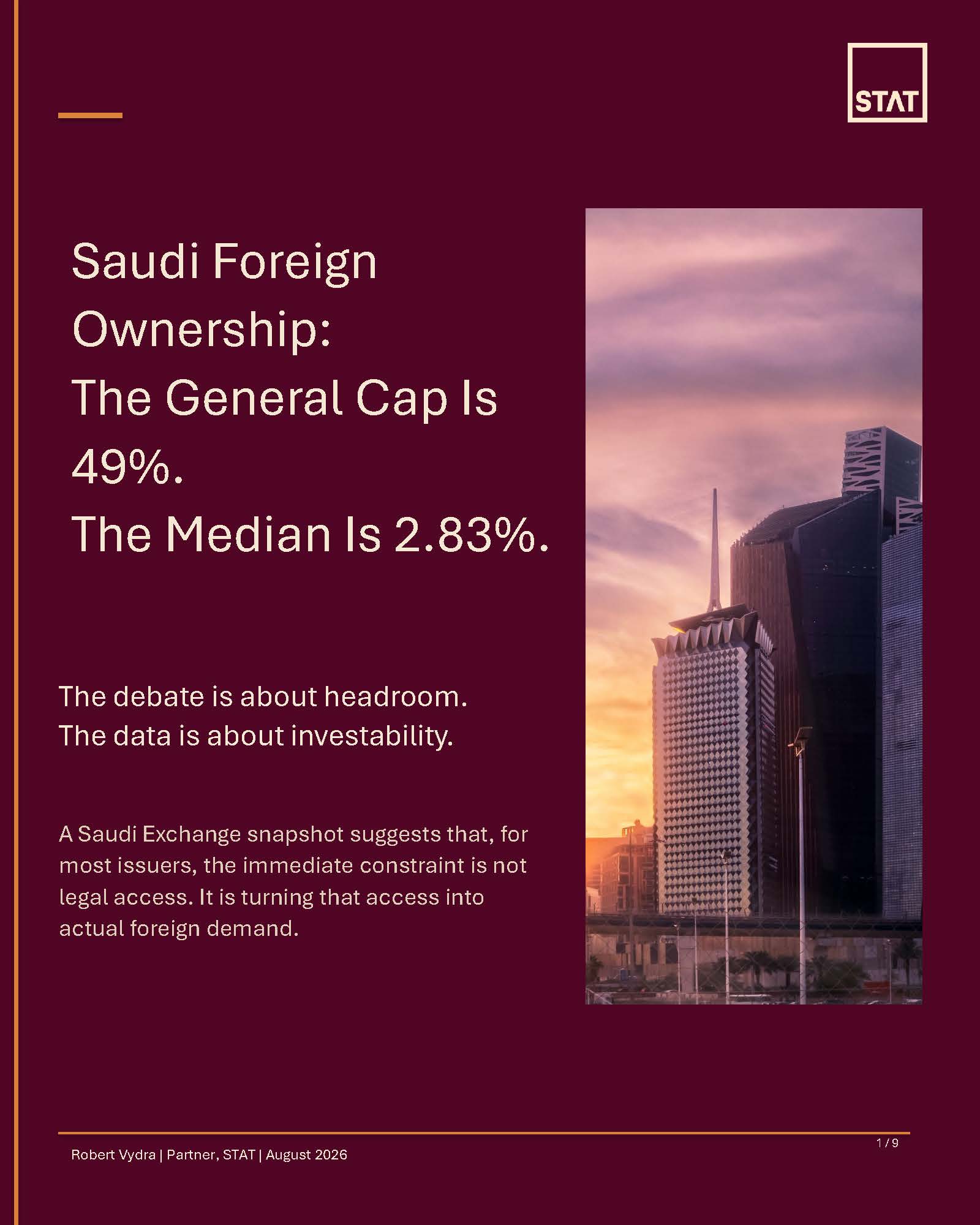
Saudi Foreign Ownership: The General Cap Is 49%. The Median Is 2.83%.
News
01.09.2026
BD Team
STAT Partner and Head of Equity Capital Markets Robert Vydra analyses the latest Saudi Exchange foreign ownership data and considers what the gap between legal ownership headroom and actual foreign participation means for Saudi listed companies and companies preparing to access the equity capital markets.
The debate around foreign ownership in Saudi listed companies is understandably focused on whether the general 49% foreign ownership cap may eventually be increased or removed. That remains important, particularly for larger issuers where foreign ownership restrictions can affect index treatment, passive flows and international market positioning.
However, an analysis of Saudi Exchange data last updated on 31 August 2026 points to a separate and more immediate issue. The analysis covers 376 listed companies, comprising 253 Main Market companies and 123 Nomu companies, of which 372 are subject to the general 49% foreign ownership limit. Median actual foreign ownership across all 376 companies is only 2.83%. Approximately 66.0% of listed companies are below 5% actual foreign ownership and 89.4% are below 10%.
The difference between the two markets is particularly notable. Median actual foreign ownership is 4.88% on the Main Market, compared with only 0.37% on Nomu, where 81.3% of issuers have actual foreign ownership below 1%.
Saudi Exchange’s “actual foreign ownership” figure excludes foreign strategic investors and includes swap interests. The analysis is point-in-time and issuer-weighted rather than market-cap weighted.
Further liberalisation could still have significant implications for Saudi capital markets, including foreign inclusion factors, index weights, passive investment flows and the Kingdom’s international market positioning. But for most individual issuers, the data suggests that the immediate challenge is not simply the legal ownership ceiling. There is already substantial unused foreign ownership headroom.
The more difficult question is how to convert legal access into sustained international investor demand. That turns the focus to investability, including free float and liquidity, the strength of the equity story, valuation, governance, management access, research coverage, disclosure quality and consistent post-listing delivery.
For companies preparing for a Main Market IPO, a Nomu IPO or a future transfer from Nomu to the Main Market, foreign-investor readiness should therefore be designed into the transaction rather than addressed only after listing.
49% defines the legal headroom. The 2.83% median shows how much remains unused.
The board-level question is consequently not only whether foreign investors are permitted to own the shares, but why they should want to own them.
Legal access creates capacity. Investability converts that capacity into ownership.
Robert Vydra
Robert Vydra is Partner and Head of Equity Capital Markets at STAT Law Firm in Riyadh. A New York-qualified lawyer, Robert has focused on…

From Nomu to the Main Market: Armah Sports Begins Its Next Chapter
News
30.08.2026
BD Team
STAT advised Armah Sports Company on both its original IPO and listing on Nomu in 2023 and its subsequent transfer to the Main Market of Saudi Exchange in 2026.
On 30 August 2026, the shares of Armah Sports Company commenced trading on the Main Market of Saudi Exchange under symbol 6022, marking an important new stage in the company’s public-markets journey.
STAT’s Equity Capital Markets team had the privilege of advising Armah on its original IPO and listing on Nomu – Parallel Market in 2023. We are proud to have continued advising the company on its transfer from Nomu to the Main Market in 2026.
There is something particularly rewarding about working with a client from the beginning of its public-markets journey and remaining alongside it as the business develops, its ambitions grow and one capital-markets milestone leads to the next.
An IPO is not the end of the story. The strongest adviser-client relationships are built over time, through the IPO process, life as a listed company and the strategic decisions that shape the issuer’s next stage of growth.
Armah’s progression also reflects an important part of STAT’s Saudi equity capital markets practice. We advise on Main Market IPOs, while also having substantial experience in significant Nomu IPOs where a subsequent transfer to the Main Market may form part of the issuer’s longer-term capital-markets strategy.
From Armah’s Nomu IPO in 2023 to its first day of trading on the Main Market on 30 August 2026, it has been a genuine pleasure to make this journey alongside the Armah team.
We congratulate Armah Sports Company, its board, management, shareholders and everyone involved in achieving this important milestone. We look forward to seeing the company’s next chapter unfold.
Considering a Nomu IPO or a Future Transfer to the Main Market?
If your company is considering a Nomu IPO, a future transfer from Nomu to the Main Market or a Main Market IPO, and you would like to discuss how to prepare the company to take advantage of the next Saudi ECM window, please contact:
Robert Vydra
Partner | Head of Equity Capital Markets
E: rvydra@statlawksa.com
M: +966 55 001 5326
Robert Vydra
Robert Vydra is Partner and Head of Equity Capital Markets at STAT Law Firm in Riyadh. A New York-qualified lawyer, Robert has focused on…

Aljoharah Altuwaijri
Aljoharah, an associate, assists clients in Project Finance, Corporate, and Equity Capital Markets matters. She advises issuers on initial…

A Broader Enforcement Framework: The Draft Amendments to the Saudi Competition Law
News
20.08.2026
BD Team
STAT shares a client alert on the draft Saudi Competition Law amendments and their implications for businesses.
STAT is pleased to share its latest client alert on the draft amendments to the Saudi Competition Law, covering the key changes proposed by the General Authority for Competition and what they mean for businesses operating in the Kingdom.
Our team continues to advise clients on competition compliance, merger control, and engagement with GAC.
Full analysis below,

Yazeed Altoaimi
Yazeed has extensive experience in Saudi Arabia and advises clients regularly in complex cross-border and domestic public and private…

Suhaib Nasreldin
Suhaib, an associate specializing in corporate, commercial, and regulatory matters, advises on complex transactions. He assists both Saudi…

STAT Advises Al Yamamah Company for Reinforcing Steel Bars on SAR 270 Million Steel Project with Italian Engineering Group Danieli
News
22.07.2026
BD Team
STAT advised Al Yamamah Company for Reinforcing Steel Bars on its SAR 270 Million Yanbu steel facility, underscoring our role in major cross-border industrial projects supporting Vision 2030.
STAT is pleased to announce that it acted as legal counsel to Al Yamamah Company for Reinforcing Steel Bars on the development of its new integrated steel production facility in Yanbu, Saudi Arabia.
With a planned production capacity of one million tonnes of steel billets per annum, the project, with an approximate value of SAR 270 million, represents a significant investment in Saudi Arabia’s industrial and manufacturing sector and will strengthen the Kingdom’s domestic steel-production capabilities. The Project brings together a leading Saudi steel manufacturer and a leading Italian engineering group, reflecting the increasingly international nature of major industrial developments in the Kingdom.
STAT advised on the drafting, review, negotiation and execution of the cross-border transaction documentation. The mandate included advising on contractual arrangements with Danieli, one of the world’s leading engineering groups for the metals industry, as well as on contractual risk allocation, commercial terms and the legal framework governing the implementation of the Project.
STAT team was led by Counsel Ruba Alharthi, supported by Associate Rilwan Shittu and Trainee Associate Ibrahim Alshinifi.
Ruba Alharthi commented: “This project reflects the continued ambition and growth of Saudi Arabia’s industrial and manufacturing sector in line with the objectives of Saudi Vision 2030. Advising on cross-border industrial projects of this nature requires not only an understanding of the local legal framework but also the ability to navigate complex international contractual arrangements. We were pleased to advise Al Yamamah Company for Reinforcing Steel Bars on this landmark cross-border transaction and to support a project that will strengthen the Kingdom’s domestic steel production capabilities.”
This mandate builds on STAT’s track record of advising leading industrial, infrastructure and manufacturing clients on complex domestic and cross-border transactions.
Ruba Alharthi
Ruba, a counsel at STAT, has extensive experience advising on high-value project development and finance transactions. She has acted for…

Rilwan Shittu
Rilwan, a corporate, finance, and capital markets associate, advises on finance, capital markets, and M&A transactions. He has provided…

Ibrahim Alshinifi
Ibrahim, a trainee associate, advises both Saudi and international clients on a wide range of matters. His experience includes corporate…