
News
08.09.2026
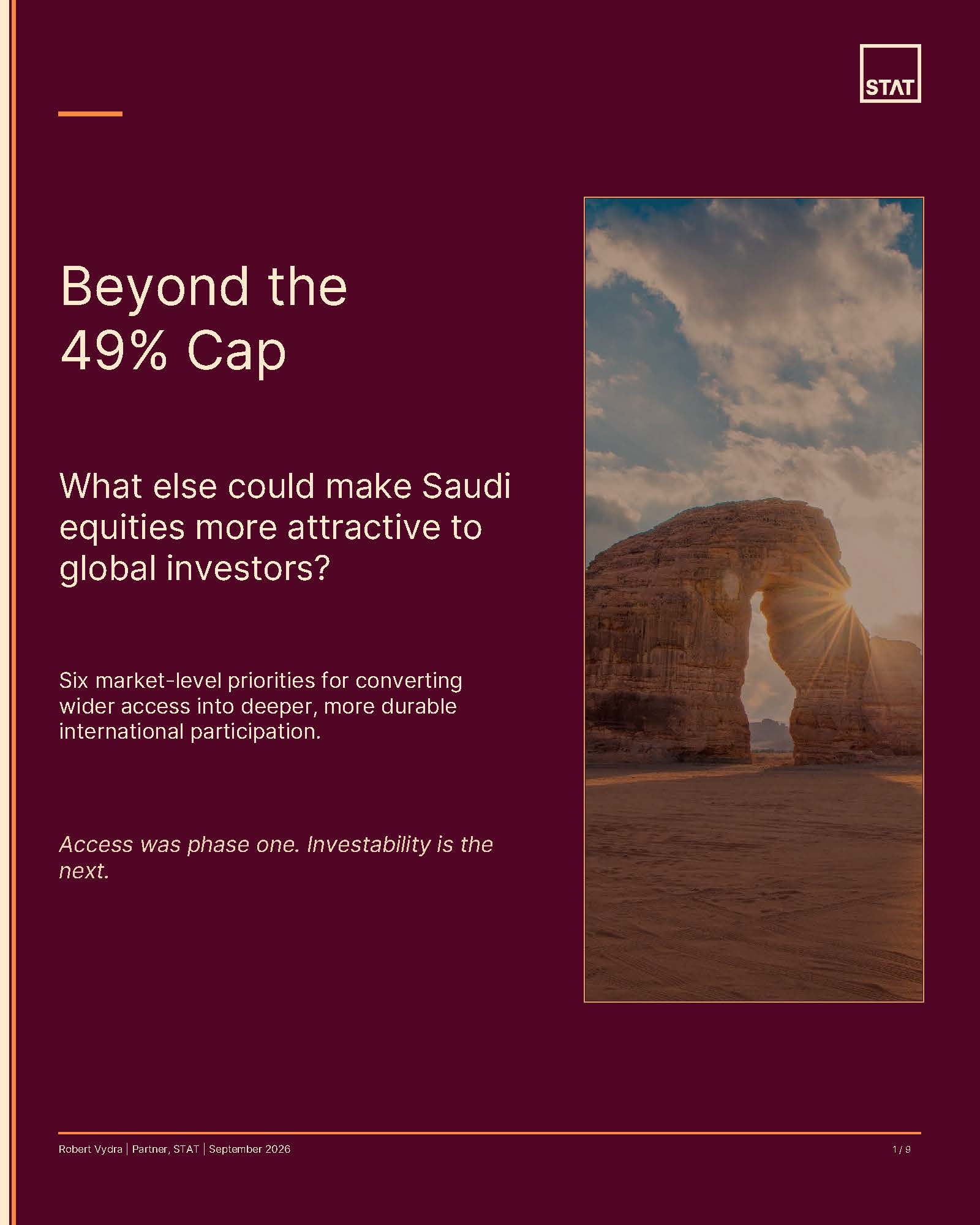
Beyond the 49% Cap: What Will Bring More Global Capital to Saudi Equities?
STAT Partner and Head of Equity Capital Markets Robert Vydra examines six market-level priorities for converting wider foreign-investor access into deeper, more durable international participation in Saudi equities.
Increasing or removing the foreign ownership cap would be an important further step in the development of Saudi capital markets. However, a higher ceiling would not, by itself, make Saudi equities more investable for international institutions.
In this analysis, Robert Vydra considers what could come next, building on the work of the Capital Market Authority and Saudi Exchange in opening access, strengthening bilingual disclosure and establishing market-making, securities-lending and covered short-selling frameworks.
Six areas that could strengthen international participation
Robert identifies six areas in which further progress could help translate wider foreign-investor access into deeper and more sustained participation in Saudi equities. These span the regulatory framework, market infrastructure and transaction practice, rather than falling within the responsibility of any single institution.
Further foreign ownership liberalisation. Further relaxation of the general foreign ownership ceiling could expand the capacity for international investment, while preserving issuer- or sector-specific restrictions where broader policy considerations justify them. The relevant question is how much additional investable capacity a change would create, rather than the headline percentage alone.
Simpler operational access. More predictable and efficient account opening, custody, beneficial ownership documentation, settlement and securities transfers would make legal access more practical. For an international institution, the time, cost and certainty involved in establishing and managing a Saudi investment position are important aspects of market accessibility.
Current information when investors commit capital. Predictable IPO timetables and the freshest practicable financial information would help investors assess an offering on a more current basis. The objective is to minimise the gap between prospectus disclosure and the information needed when investors decide whether, and at what valuation, to commit capital.
Deeper liquidity, not merely eligibility. Meaningful free float, broader institutional allocations, wider market-making coverage, deeper securities lending and efficient block liquidity could strengthen the institutional aftermarket. The practical test is whether investors can build, manage and exit meaningful positions efficiently, not simply whether they are permitted to hold the shares.
Market data that global institutions can use readily. More accessible, consistently structured and machine-readable financial information, historical disclosures, operating metrics and free-float data could make Saudi issuers easier to analyse and compare. The opportunity lies in helping international institutions integrate Saudi market information directly into their research and investment processes.
Measures of participation, not only permission. A broader assessment of market development would look beyond legal eligibility to foreign ownership as a percentage of free float, international institutional participation in IPO books, trading depth, breadth of ownership across issuers and post-listing retention. Together, these measures would provide a fuller picture of whether wider access is translating into durable international investment.
A high ownership ceiling has limited practical value if an institution cannot efficiently build or exit a meaningful position. Similarly, legal access cannot achieve its full potential where investors face operational friction or an information gap when pricing an offering.
This is a next-stage agenda, not an argument that the market has stood still. The opportunity is to build on the Kingdom’s reforms and secure a larger, more durable place for Saudi equities in global portfolios.
Access was the first phase. Investability is the next.
For companies preparing for a Main Market IPO, the practical implication is to consider international-investor expectations early, when the offering structure, disclosure and aftermarket strategy are being developed.
To discuss how these considerations could shape your company’s public-markets plans, please contact:
Robert Vydra
Partner | Head of Equity Capital Markets
E: rvydra@statlawksa.com
M: +966 55 001 5326
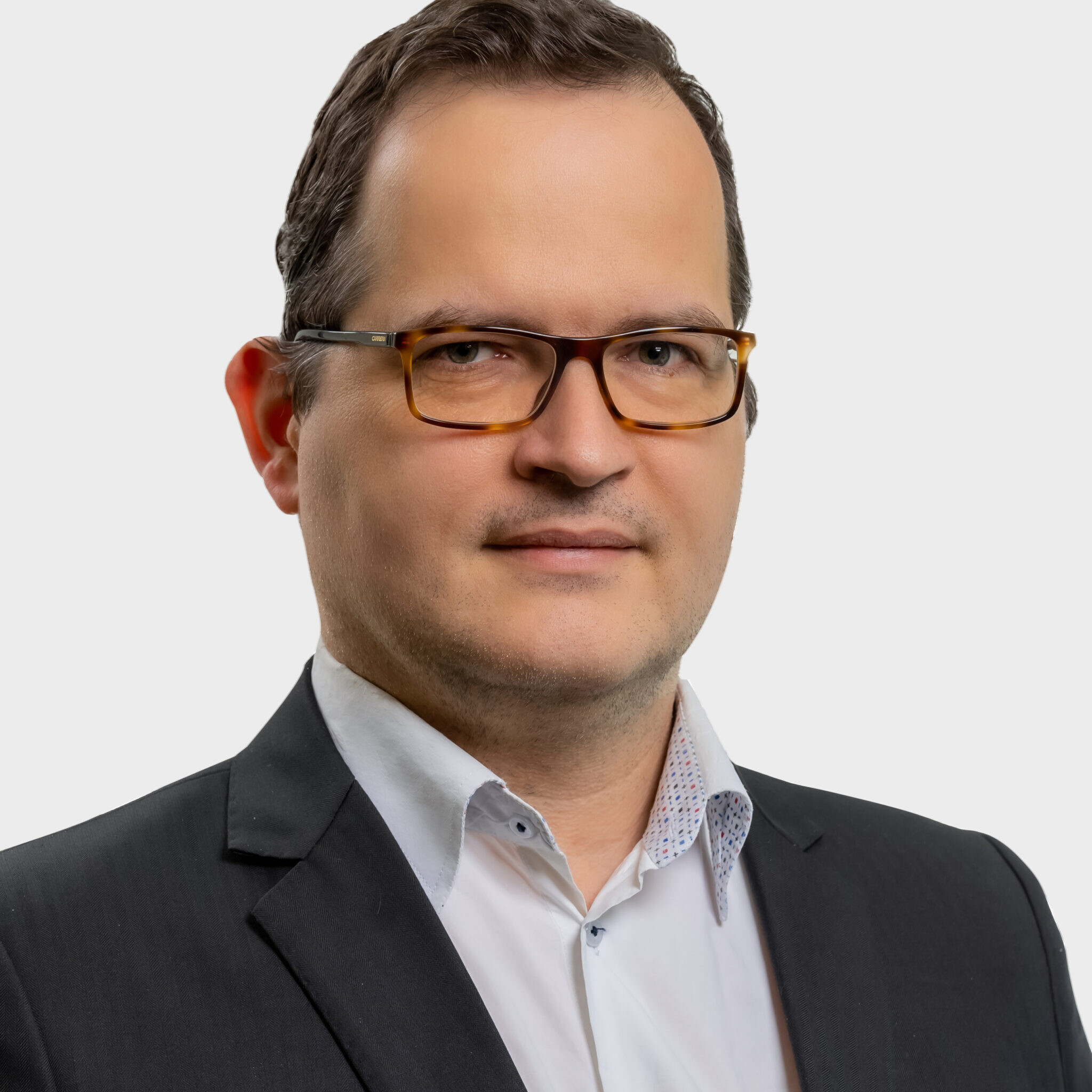
Robert Vydra
Robert Vydra is Partner and Head of Equity Capital Markets at STAT Law Firm in Riyadh. A New York-qualified lawyer, Robert has focused on…