
News
14.09.2026
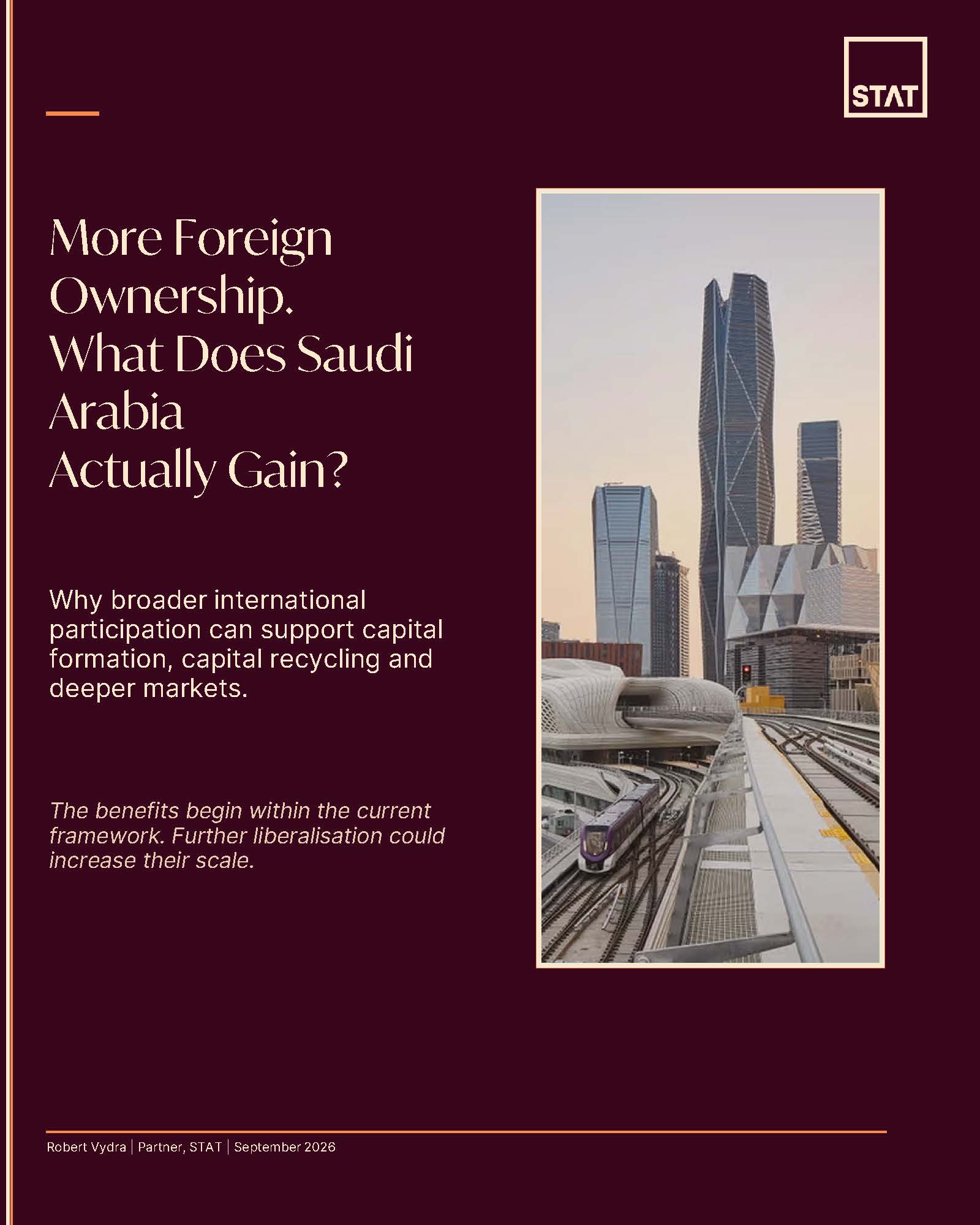
More Foreign Ownership: What Does Saudi Arabia Actually Gain?
In the final instalment of his four-part series on foreign investment in Saudi equities, STAT Partner and Head of Equity Capital Markets Robert Vydra examines how broader international participation can support corporate funding, domestic capital recycling and deeper Saudi capital markets.
The debate around foreign ownership in Saudi equities often focuses on the percentage: how much international investors are permitted to own, and whether that ceiling should rise. The more important economic question is what a broader international investor base can actually do for Saudi companies, Saudi capital markets and the wider economy.
The answer is broader than simply “bringing money in”. Foreign capital can support the economy through three connected channels: direct capital formation, domestic capital recycling and market deepening. These benefits can arise within the existing framework; further liberalisation could increase their scale.
Fresh equity for Saudi corporate growth
Where foreign investors subscribe for newly issued shares in an IPO, follow-on offering or rights issue, the link is direct. The company receives fresh equity that can fund expansion, capital expenditure, acquisitions or working capital without increasing leverage. Equity proceeds can also be used to repay debt and strengthen the balance sheet.
This distinction matters when discussing the economic contribution of an offering. An IPO may involve new shares, existing shares sold by shareholders, or a combination of both. The company receives the proceeds attributable to the new shares it issues, rather than the proceeds of shares sold by existing shareholders.
Broader international demand can therefore expand the pool of capital available to Saudi businesses, while the offering structure determines who receives that capital.
Domestic capital recycling when existing shares change hands
When a foreign investor buys existing shares, the purchase price goes to the selling shareholder, not the issuer. That does not mean the transaction has no wider economic benefit.
A Saudi shareholder who sells gains liquidity that may be reinvested in another listed company, an IPO, an investment fund, sukuk, a private business or a new project. The proceeds may also be deposited with a Saudi financial institution or spent elsewhere in the domestic economy.
Where proceeds are redeployed in the Kingdom, foreign demand can help mobilise Saudi capital for other economic uses. This is a capital-recycling channel, distinct from the direct funding a company receives when it issues new shares.
The qualification is important: domestic reinvestment is not automatic. A selling shareholder may retain the proceeds or invest them abroad. The economic effect depends on what happens after the shares are sold.
Deeper liquidity and better price discovery
A broader investor base can bring different investment mandates, time horizons, valuation views and sector expertise to the market. That diversity can increase the range of potential buyers and sellers and help investors transact meaningful positions without excessive price impact.
Institutional research and analysis can also help prices respond more closely to company-specific information. The potential gain is a market with greater depth and more informative pricing, rather than simply a higher volume of foreign trading.
A credible secondary market also supports future primary capital raising. It can provide valuation benchmarks, more credible exits for existing shareholders and greater confidence in the prospects for subsequent IPOs, follow-on offerings and rights issues. It may also make listed shares more useful as acquisition currency.
More foreign participation can support these outcomes, but cannot guarantee them.
A potentially lower cost of equity
A wider pool of investors, deeper liquidity and greater competition among providers of capital may reduce part of the premium investors demand for holding shares that are difficult to trade. Over time, this could lower the cost of equity and make future capital raisings more viable.
The effect is conditional. Earnings, cash flow, growth quality, governance, valuation, free float and market conditions remain central to the investment case. International demand can improve pricing efficiency, but it cannot compensate indefinitely for weak fundamentals or poor post-listing delivery.
For Saudi issuers, attracting foreign capital is therefore connected to the quality of the business and its public-market proposition, not merely the availability of ownership capacity.
Stronger governance, disclosure and global integration
Long-term institutional ownership can influence more than the shareholder register. Engaged investors can reinforce expectations around board oversight, related-party transactions, minority-shareholder protection, capital allocation and management accountability.
International scrutiny can also raise expectations for accessible English-language information, meaningful operating indicators, risk transparency and consistent reporting. These expectations make disclosure quality and investor communication important components of the relationship between a listed company and its shareholders.
Broader international ownership can support analyst attention, comparison with regional and global peers, and greater relevance within global portfolios. The strategic opportunity is for Saudi equities to become a durable allocation for international institutions rather than an episodic trade.
The objective is durable participation, not maximum inflows
Foreign portfolio investment also brings risks. Flows can reverse, global risk-off episodes can affect local markets, and herd behaviour can amplify price movements. An investor base concentrated in a narrow segment, or dominated by short-term or highly leveraged capital, may be less resilient than headline inflow figures suggest.
The objective should therefore be a broad, diversified and durable institutional investor base. Assessing success requires attention to the quality and composition of participation, alongside its scale.
For Saudi companies preparing to raise equity, the practical implication is to consider how offering structure, governance, disclosure and investor engagement can help attract and retain that investor base. For the market as a whole, the opportunity is to connect international demand with productive investment and more effective capital allocation.
Foreign ownership is not the objective. Better capital allocation, deeper markets and greater funding capacity for Saudi companies are.
To discuss how your company can position itself to attract and retain international capital, or how these considerations could shape its IPO or other equity capital markets plans, please contact:
Robert Vydra
Partner | Head of Equity Capital Markets
STAT Law Firm
E: rvydra@statlawksa.com
M: +966 55 001 5326
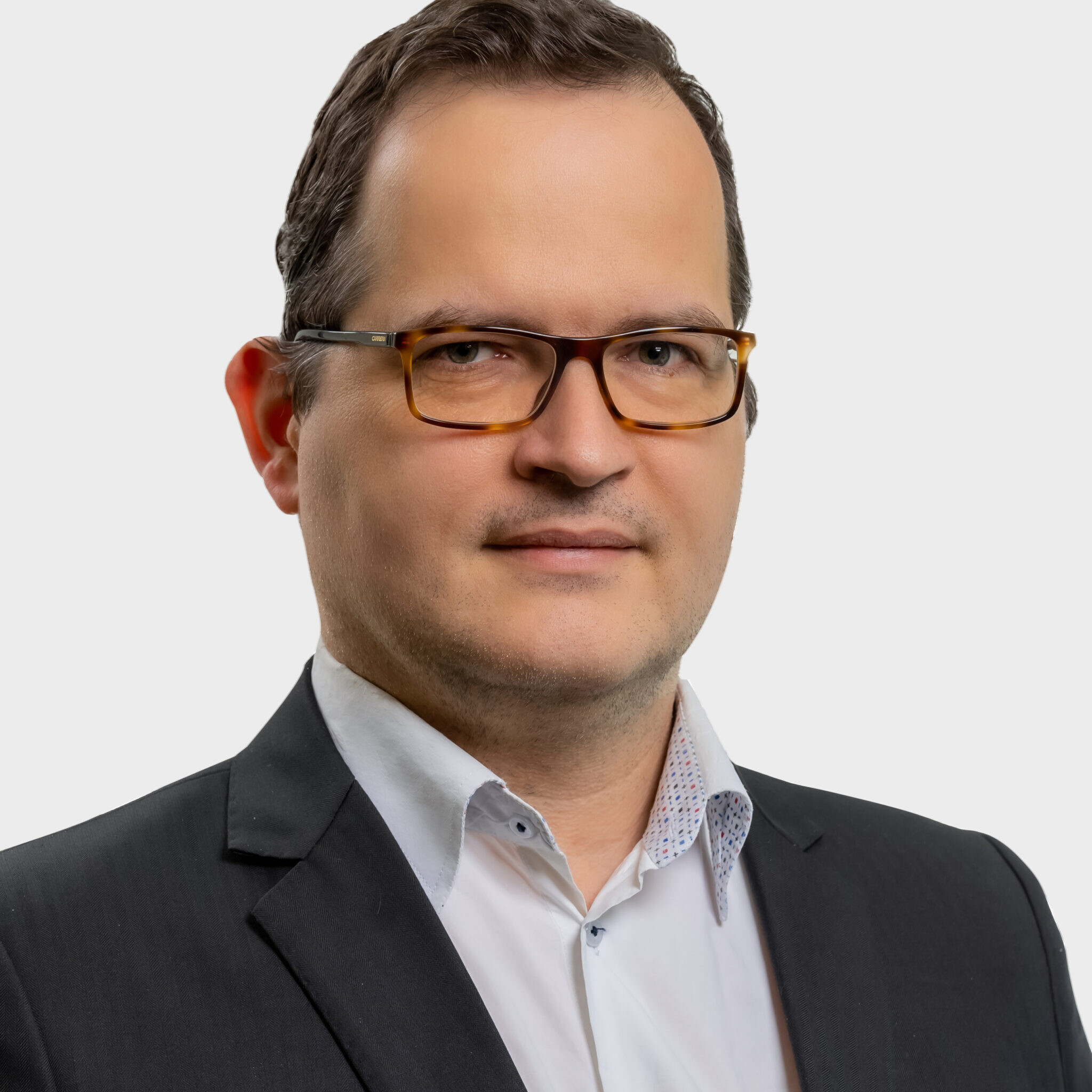
Robert Vydra
Robert Vydra is Partner and Head of Equity Capital Markets at STAT Law Firm in Riyadh. A New York-qualified lawyer, Robert has focused on…