
News
01.09.2026
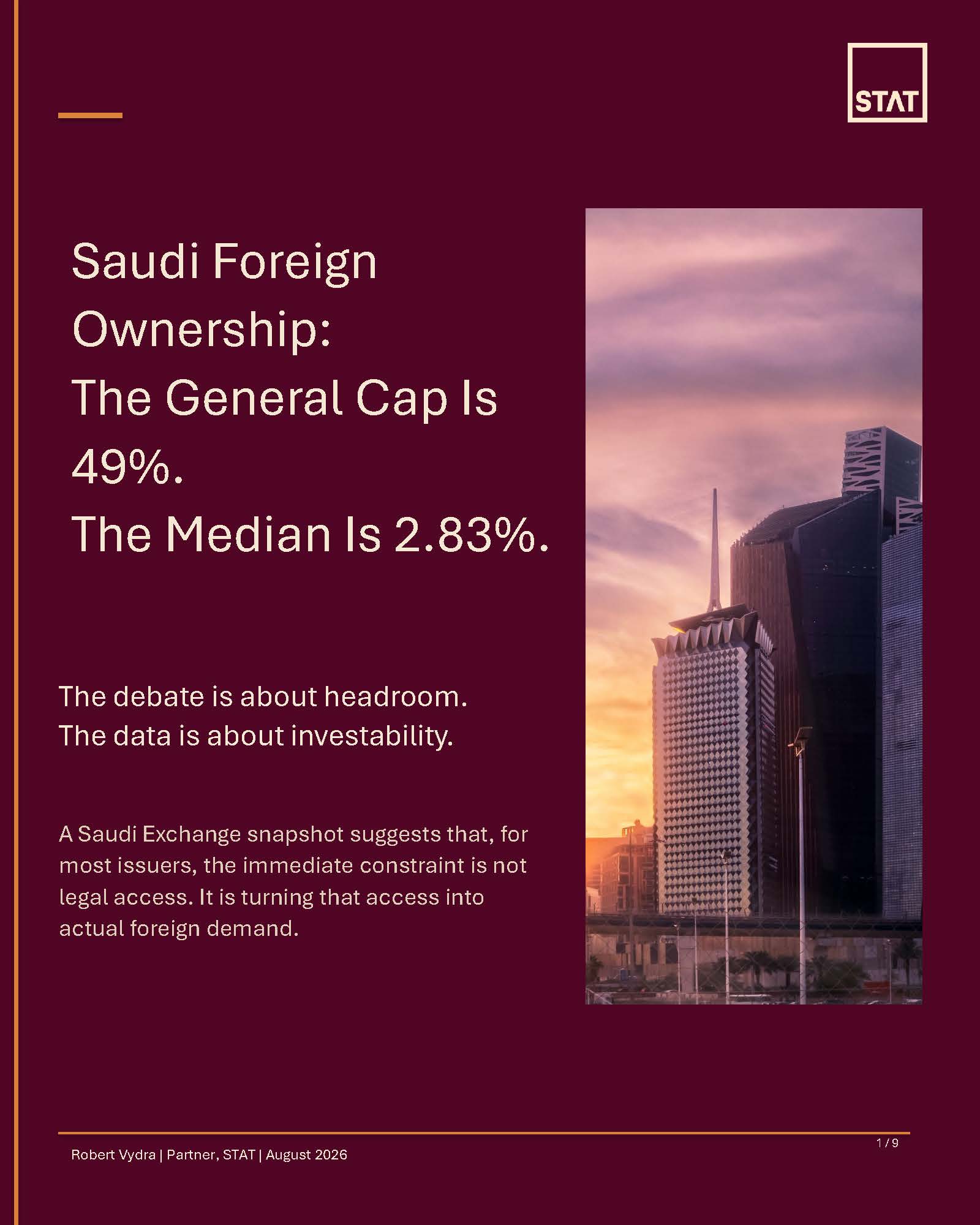
Saudi Foreign Ownership: The General Cap Is 49%. The Median Is 2.83%.
STAT Partner and Head of Equity Capital Markets Robert Vydra analyses the latest Saudi Exchange foreign ownership data and considers what the gap between legal ownership headroom and actual foreign participation means for Saudi listed companies and companies preparing to access the equity capital markets.
The debate around foreign ownership in Saudi listed companies is understandably focused on whether the general 49% foreign ownership cap may eventually be increased or removed. That remains important, particularly for larger issuers where foreign ownership restrictions can affect index treatment, passive flows and international market positioning.
However, an analysis of Saudi Exchange data last updated on 31 August 2026 points to a separate and more immediate issue. The analysis covers 376 listed companies, comprising 253 Main Market companies and 123 Nomu companies, of which 372 are subject to the general 49% foreign ownership limit. Median actual foreign ownership across all 376 companies is only 2.83%. Approximately 66.0% of listed companies are below 5% actual foreign ownership and 89.4% are below 10%.
The difference between the two markets is particularly notable. Median actual foreign ownership is 4.88% on the Main Market, compared with only 0.37% on Nomu, where 81.3% of issuers have actual foreign ownership below 1%.
Saudi Exchange’s “actual foreign ownership” figure excludes foreign strategic investors and includes swap interests. The analysis is point-in-time and issuer-weighted rather than market-cap weighted.
Further liberalisation could still have significant implications for Saudi capital markets, including foreign inclusion factors, index weights, passive investment flows and the Kingdom’s international market positioning. But for most individual issuers, the data suggests that the immediate challenge is not simply the legal ownership ceiling. There is already substantial unused foreign ownership headroom.
The more difficult question is how to convert legal access into sustained international investor demand. That turns the focus to investability, including free float and liquidity, the strength of the equity story, valuation, governance, management access, research coverage, disclosure quality and consistent post-listing delivery.
For companies preparing for a Main Market IPO, a Nomu IPO or a future transfer from Nomu to the Main Market, foreign-investor readiness should therefore be designed into the transaction rather than addressed only after listing.
49% defines the legal headroom. The 2.83% median shows how much remains unused.
The board-level question is consequently not only whether foreign investors are permitted to own the shares, but why they should want to own them.
Legal access creates capacity. Investability converts that capacity into ownership.

Robert Vydra
Robert Vydra is Partner and Head of Equity Capital Markets at STAT Law Firm in Riyadh. A New York-qualified lawyer, Robert has focused on…